

5 Ways to Overcome Impostor Syndrome as a CFO/Business Advisor
We train a lot of accountants and bookkeepers on how to start an advisory service. And, there's always one major obstacle that holds many financial professionals back: impostor syndrome.
Impostor syndrome is a psychological occurrence in which an individual doubts their skills, talents, or accomplishments and has a persistent internalized fear of being exposed as a fraud.
In other words, these financial professionals are saying to themselves:
"I think I'm a phony and it's only a matter of time before everyone finds out."
If you becoming an advisor to business owners is the next logical step in your career, here's five ways to overcome impostor syndrome:
Way #1: Know that this feeling is normal.
Impostor syndrome has been proven to disproportionately affect high-achieving individuals. Which means that if you are experiencing this, it's more likely because you're a high achiever instead of a true impostor.
According to the "Dunning-Kruger" effect (Dunning & Kruger were two psychologists), those that know a lot about a topic know that there is a lot that they don't know.
And, so, their confidence goes down.
This is why it's more typical of an experienced doctor who specializes in a field to feel more of an impostor than a first-year medical student!
So, just know that this feeling is normal for someone like yourself who is a high achiever. In fact, not having impostor syndrome would most likely indicate that something is wrong!
Way #2: Know that you know more than you think you do - especially as it relates to financials.
Most business owners are experts in their field. Their industry. Their business.
They are most likely not an expert in business financials, in business strategy, in knowing how to improve cash flow, in growing profitable businesses or knowing the specific drivers they need to improve the most.
These are all financial concepts.
With some training and experience, you will know more than the average business owner in the area of financials.
Way #3: Know the Competence-Confidence Loop.
To avoid feeling like an impostor, we must get good at something. Well, how do we get good at something?
By taking action!
According to the Competence-Confidence Loop: Action breeds Competence, and Competence breeds Confidence.
And, once we're confident at something, we tend to do it more often (take more action) and thus the loop repeats itself.
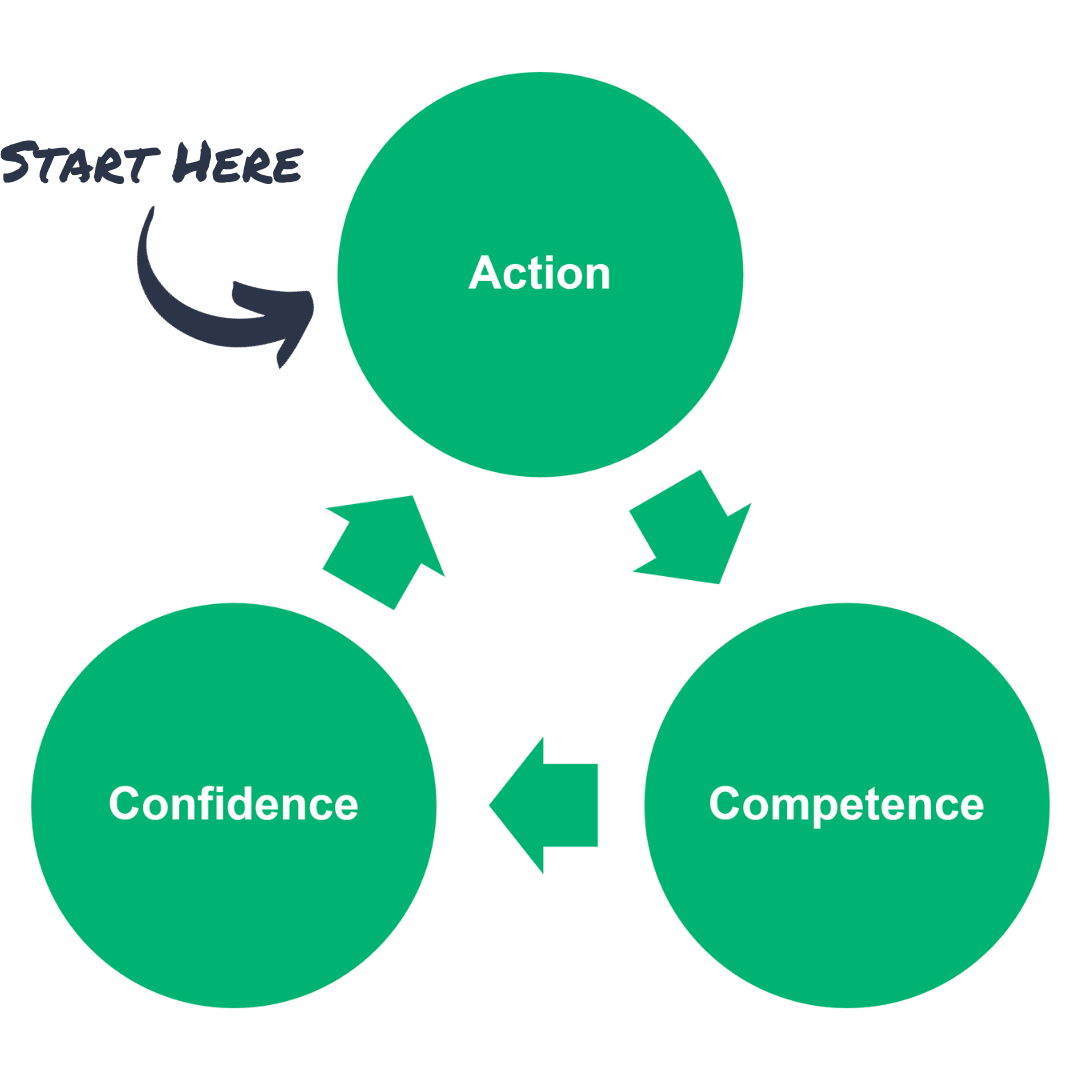
So, instead of feeling like we must have the confidence (the opposite of impostor syndrome) before we can begin, a better place to start is to take action which will ultimately provide the thing that we want the most (confidence).
Way #4: Know that our job is to guide - not do.
Our job, as CFOs/Advisors to small-to-medium sizes businesses, is to guide the business owner on how to have a successful business.
Not do.
Because of this, we don't have to be the expert at our clients' business or industry. We just have to get good at guiding clients. At getting clients to take action.
Specifically, we need to get good at guiding our clients to do one thing: generating positive cash flow on a consistent basis in their business.
Let your client be the expert in their field. You just need to become an expert at guiding them to generate positive cash flow on a consistent basis.
Way #5: Know that you can do what a CFO/Advisor is supposed to.
At the end of the day, regardless if you call yourself an outsourced CFO or business advisor, your role is to: be someone that your client can trust, to guide them, on having a successful business.
Can you be someone that your clients can trust? Absolutely.
Can you be someone that can guide them on having a successful business? Absolutely (with some training, support, and resources.)
So, no need to feel like an impostor.
Impostor syndrome is a psychological occurrence in which an individual doubts their skills, talents, or accomplishments and has a persistent internalized fear of being exposed as a fraud.
In other words, these financial professionals are saying to themselves:
"I think I'm a phony and it's only a matter of time before everyone finds out."
If you becoming an advisor to business owners is the next logical step in your career, here's five ways to overcome impostor syndrome:
Way #1: Know that this feeling is normal.
Impostor syndrome has been proven to disproportionately affect high-achieving individuals. Which means that if you are experiencing this, it's more likely because you're a high achiever instead of a true impostor.
According to the "Dunning-Kruger" effect (Dunning & Kruger were two psychologists), those that know a lot about a topic know that there is a lot that they don't know.
And, so, their confidence goes down.
This is why it's more typical of an experienced doctor who specializes in a field to feel more of an impostor than a first-year medical student!
So, just know that this feeling is normal for someone like yourself who is a high achiever. In fact, not having impostor syndrome would most likely indicate that something is wrong!
Way #2: Know that you know more than you think you do - especially as it relates to financials.
Most business owners are experts in their field. Their industry. Their business.
They are most likely not an expert in business financials, in business strategy, in knowing how to improve cash flow, in growing profitable businesses or knowing the specific drivers they need to improve the most.
These are all financial concepts.
With some training and experience, you will know more than the average business owner in the area of financials.
Way #3: Know the Competence-Confidence Loop.
To avoid feeling like an impostor, we must get good at something. Well, how do we get good at something?
By taking action!
According to the Competence-Confidence Loop: Action breeds Competence, and Competence breeds Confidence.
And, once we're confident at something, we tend to do it more often (take more action) and thus the loop repeats itself.
So, instead of feeling like we must have the confidence (the opposite of impostor syndrome) before we can begin, a better place to start is to take action which will ultimately provide the thing that we want the most (confidence).
Way #4: Know that our job is to guide - not do.
Our job, as CFOs/Advisors to small-to-medium sizes businesses, is to guide the business owner on how to have a successful business.
Not do.
Because of this, we don't have to be the expert at our clients' business or industry. We just have to get good at guiding clients. At getting clients to take action.
Specifically, we need to get good at guiding our clients to do one thing: generating positive cash flow on a consistent basis in their business.
Let your client be the expert in their field. You just need to become an expert at guiding them to generate positive cash flow on a consistent basis.
Way #5: Know that you can do what a CFO/Advisor is supposed to.
At the end of the day, regardless if you call yourself an outsourced CFO or business advisor, your role is to: be someone that your client can trust, to guide them, on having a successful business.
Can you be someone that your clients can trust? Absolutely.
Can you be someone that can guide them on having a successful business? Absolutely (with some training, support, and resources.)
So, no need to feel like an impostor.
Related Advice


Live Training this Wednesday for Accountants, Bookkeepers & Tax Professionals
Escape the accountant's trap and create a business that works for you!
Escape the accountant's trap and create a business that works for you!
Discover how to grow your practice this year through CFO Advisory services.
Discover how to grow your practice this year through CFO Advisory services.
Finally escape the accountant's trap (of trading time for money) and join the hundreds of other financial professionals who have made the transition to offering high-ticket CFO Advisory services.
In this training you'll discover the proven system for getting clients and providing an effective (and efficient!) CFO Advisory service.
This training is eligible to receive CPE credit.
In this training you'll discover the proven system for getting clients and providing an effective (and efficient!) CFO Advisory service.
This training is eligible to receive CPE credit.
Become a CFO Advisor
Done-With-You Mentorship Program
Success Stories
Join a Right-Fit Call
Done-With-You Mentorship Program
Success Stories
Join a Right-Fit Call
General Inquires
contact@thecfoproject.com
Interested in Partnerships?
annemarie@thecfoproject.com
Member Login to the CFO Hub
contact@thecfoproject.com
Interested in Partnerships?
annemarie@thecfoproject.com
Member Login to the CFO Hub


Privacy Policy | Terms of Service
Copyright 2025 - The CFO Project®
Copyright 2025 - The CFO Project®