

Five Challenges Facing Most Small Business Owners
According to the SBA, half of all businesses never make it to their fifth birthday.
Half!
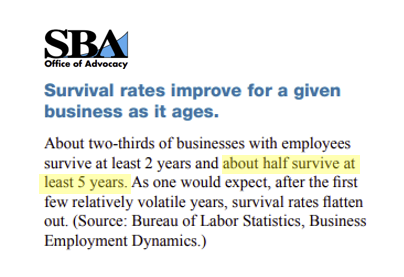
Yet, almost all of these failed businesses all had bookkeepers and accountants.
This further proves the point that business owners need (read: crave) direction from someone they trust to tell them what to do to have a growing and more profitable business.
Enter you. Their business advisor or CFO.
Why do business owners want this? Because they're facing a few main challenges.
Challenge #1: The business relies on the owner, or it all falls apart
Business owners are already working as hard as they can. If they take a day off, their business doesn’t run as smoothly. They’re working incredibly hard with little to show.
Their employees are typically making more money than the owner (with much less risk, stress, and work)!
The owner feels like they are on a hamster wheel going 90-mph; they’re tired and overworked but they’re afraid to get off that wheel for fear of their business falling apart.
Challenge #2: The business owner is constantly battling a ‘catch-22’ situation.
They want to grow their business but need cash to do so…but, they can’t get more cash without growing their business. The catch-22!
Most business owners started their business because they are an expert at their ‘craft’ (i.e. a dentist starts a dental business), they want freedom of time (being in control of their time), and they want freedom of money (being able to make as much as they want).
However, because there is the perpetual ‘lack of cash’ the business owner simply is forced to work harder to compensate and, thus, becomes the bottleneck.
The only way to remove themselves as the bottleneck is to generate more cash…
…but they have no idea how to do this.
Challenge #3: The business owner doesn’t have a simple way to understand what’s working – and what’s not – in their business
The typical financials (P&L, Balance Sheet, Statement of Cash Flows) are made for accountants – not business owners.
They are confusing…and they don’t tell the whole story (where are leads and retention rate on those reports?).
It’s hard for a business owner to know what’s working – and what’s not – simply by looking at these reports.
To make matters worse, the ‘numbers people’ in their lives (like their accountant and bookkeeper) seem to always be speaking a foreign language.
How can business owners make decisions when they don’t understand what’s going on in their business?
Challenge #4: The business owner does not have clear goals
Most business owners don’t have clear and well thought out goals for the things that matter most (the metrics that drive revenue, profit and cash flow).
How can a business owner know if they’re making progress daily/weekly/monthly if they don’t know where they want to end up?
This is the equivalent of getting in the car and driving without a clear destination…you’ll waste a lot of gas and a lot of time.
However, this is typical of most business owners – they’re ‘driving’ without knowing exactly where they want to end up.
Challenge #5: The business owner does not have a clear path to follow to have a growing and more profitable business
Business owners are incredibly busy every day. However, the majority of the things they work on daily (i.e. fighting fires) are not going to make a difference on the things that matter most: increasing profitability and cash flow.
Because no one is giving them guidance they are relying on their ‘gut’ and ‘intuition’ – which is usually spot on when it comes to the craft (i.e. dentistry tasks) but not strategic tasks (i.e. making more money).
They simply don’t know what to do next to have a growing and more profitable business.
Because of these challenges, the business owner needs help. Specifically, they need someone who understands the entire business and can help them improve it.
They need you.
If the business owner doesn’t solve those 5 key challenges, they will typically experience a range of emotional problems:
They will experience frustration:
- A business owner typically will resign to coming into work every day and work in the business.
- Then, they look up a year or two later and realize they haven’t made meaningful progress.
- They are nowhere close to achieving the freedom of money and time that they desperately want.
- Instead, they are left with a very stressful job that they happen to own.
- A very stressful job that doesn’t provide the type of income that the business owner deserves – especially for the long hours and the sacrifices that they made.
They also experience stress:
- This is an emotional struggle. When things are not going well for a business owner it affects them emotionally.
- They become stressed over money.
- They feel defeated because they end up having to work harder while losing more freedom and time.
- They get angry at their in-ability to make money (“everyone else is making money – why can’t I?”).
- Relationships with their spouse, family, and friends deteriorate.
- They’re embarrassed (clients will tell us things their spouse doesn’t even know).
- Their mood changes.
- They become less confident in themselves.
- They think about what others may think of them if they fail.
- They doubt they’ll be able to cross the “financial finish line”.
They also experience isolation:
- They are desperate for help.
- Their accountant is not getting paid to help them (they are compliance oriented).
- Their bookkeeper is not trained to help them.
- Their spouse is not equipped (mentally or emotionally) to help them; they may encourage them, but they don’t have the tools to help solve their problems.
The bottom line is that business owners are desperate. They need your help.
This is why offering a CFO or business advisory service is so important.
Related Advice


Escape the accountant's trap and create a business that works for you!
Discover how to grow your practice this year through CFO Advisory services.
In this training you'll discover the proven system for getting clients and providing an effective (and efficient!) CFO Advisory service.
This training is eligible to receive CPE credit.
Free Training
How to Become a CFO to Small Businesses
contact@thecfoproject.com
Interested in Partnerships?
partnerships@thecfoproject.com
Member Login to the CFO Hub


Copyright 2026 - The CFO Project®